At Festival Drayton Centre
Hungarian pianist Daniel Lebhardt introduced himself saying “I want to share with you this music that I love. Music that is so inventive in exploring what this instrument can achieve.” He gave more detail, inviting with personable humility both curiosity and humour in the Festival Centre audience. Then he brought his hands down on the keys of the Yamaha Grand and seemed transformed into an elemental force of nature.
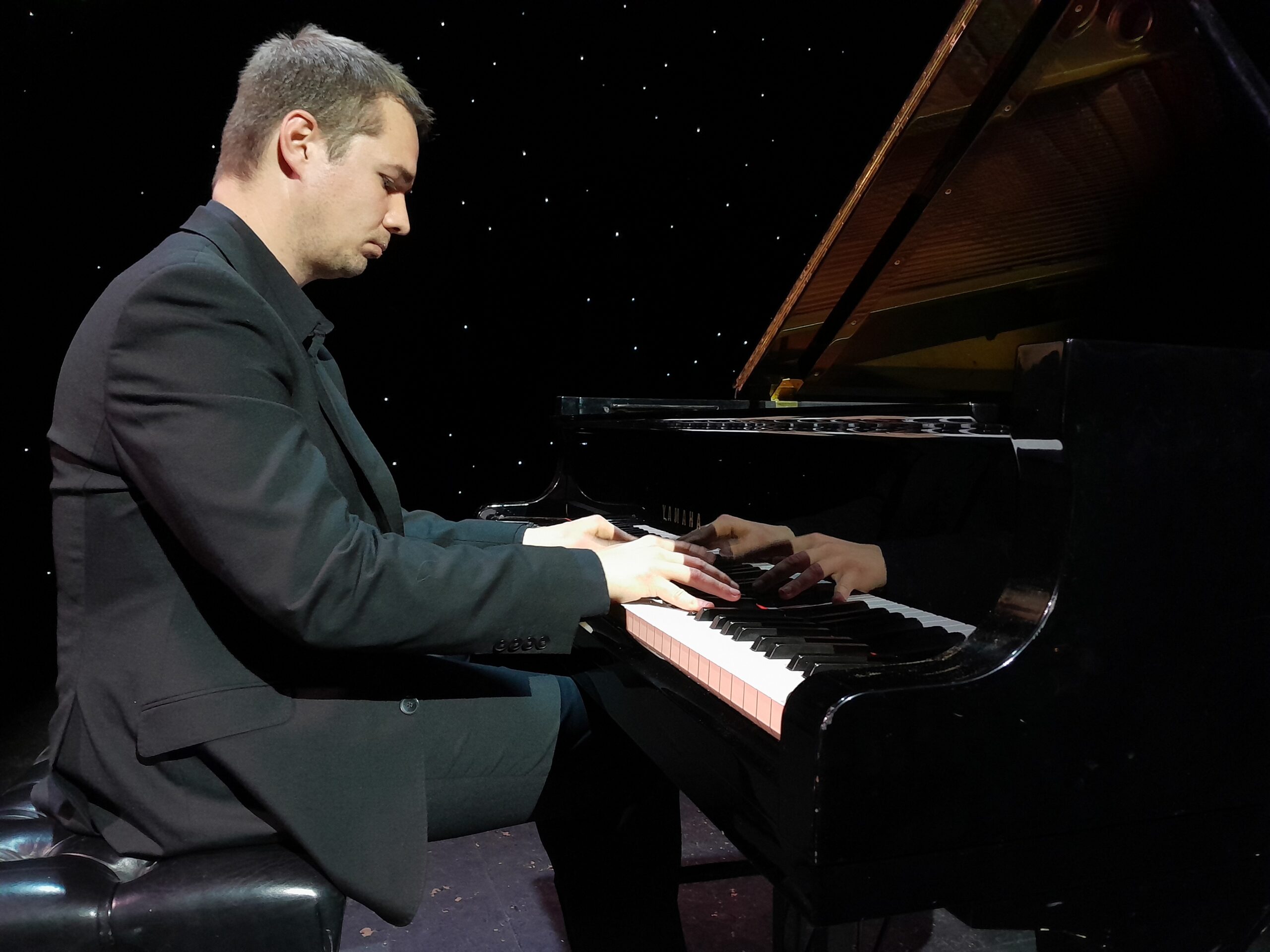
The four Ballades which Brahms wrote at the tender age of 21 could have been a deceptive opening with their moments of deep lyricism and contemplative calm. But the rich texture of sounds erupted in segments that were either grim or disturbing and we had an immediate indication that Lebhardt was taking us on a thrilling exploration likely to touch on the profound.
This set up perfectly the piece that followed: the third sonata by Scriabin, named by him ‘The State of the Soul’. In an astonishingly accomplished interpretation, Lebhardt moved seamlessly from the turbulence of the first movement – ‘The soul free and wild, thrown into the whirlpool of suffering and strife’ according to the composer – to an Andante of which Scriabin said ‘Here the stars are singing!’
Lebhardt later played Scriabin’s final piano composition Vers La Flamme, written ominously in 1914 and portraying in six tumultuous minutes the violent destruction of the earth.
In the second half of the recital, Lebhardt alternated compositions by two fellow Hungarians, György Ligeti and Béla Bartók. With any remnant of the romantic era left behind, the emphasis now was on complex rhythmic structures, with many layers of sound working at different speeds to create impressions that ranged, as Lebhardt described and then demonstrated, from the ethereal to the wretched.
The Ligeti studies Autumn in Warsaw, Vertigo, and White on White undoubtedly left many in the audience wondering how Lebhardt could possibly remember all those notes, and how his fingers could hit them at such speed (Vertigo took him over nine months to learn during lockdown). But that sense of wonder must surely have expanded for most into something deeper and more personal. Lebhardt used every one of the piano’s eighty-eight keys, and out of these pieces created magic.
Bartók’s Out of Doors from 1926 completed the recital, with sophisticated and technically challenging rhythms recreating the simplicity of Hungarian village life. Lebhardt professed to liking most the fourth piece in the suite, imitating the eerie night sounds of crickets and frogs.
This review first appeared in the Market Drayton Advertiser